


Today’s classrooms have students from diverse backgrounds and with varying abilities, facilitating greater interaction among all. Here, we’ll discuss a guide for teachers to design assessments for mixed-ability classrooms and the role of AI question generators in the process.
EdTech classrooms have gained popularity in recent years as educational institutions have adopted new technologies to create inclusive and holistic learning environments. Students from diverse backgrounds and with different abilities can belong to the same classroom and still experience personalized learning. Mixed-ability classrooms can bridge the gap between students and help everyone showcase their strengths.
According to The Business Research Company, the EdTech and smart classroom market was $185.78 billion in 2024 and expected to grow at a CAGR (compound annual growth rate) of 19.5% to reach $434.96 billion by 2029. While North America has the largest market share, the Asia Pacific is the fastest-growing region in EdTech adoption.
Mixed-ability classrooms contain students of diverse talents, learning styles, academic abilities, and social/ cultural backgrounds. Instead of segregating students based on their performance, such classrooms have students with varied strengths and weaknesses, thus allowing them to learn together, help each other, and grow as a group. Given the diverse nature of such a student group, the classroom assessment strategies have to be in a similar vein and aligned with each student’s learning ability.
In this blog, we’ll read more about designing differentiated assessments for such classrooms and how AI question generators are a powerful solution to assist teachers in this process.
Key Principles of Differentiated Assessments
Differentiated classroom assessments are meant to be diverse, varied, and suitable to test students based on their individual abilities, strengths, weaknesses, learning styles, etc. A one-size-fits-all approach will not work in such instances. The following principles should be considered.
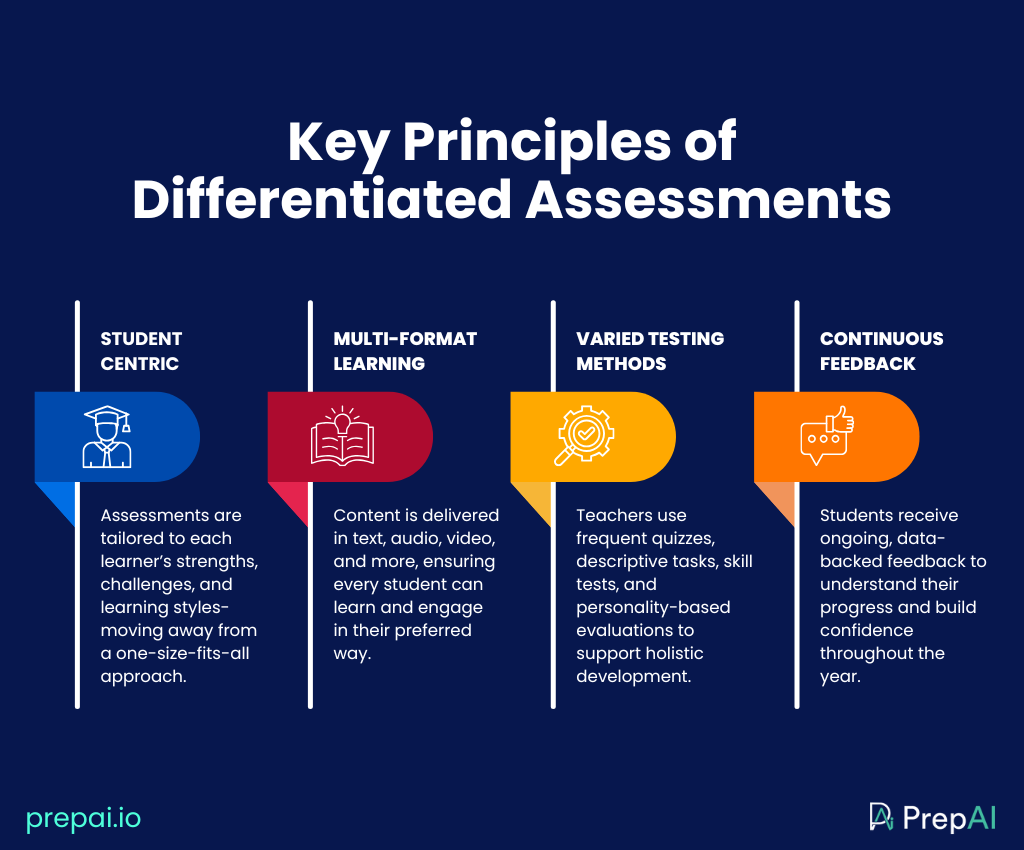
Student-Centric Approach
Instead of adopting the conventional approach where everyone is evaluated for the same set of rules and standards, differentiated assessments are student-centric, aligning with personalized learning strategies and focusing on how to accurately measure each student’s abilities.
Multiple Engagement Methods
The study material and lessons are created to cater to varied learning styles by recognizing what students prefer. The same content is provided in text, audio, video, etc., so that every student can choose a medium of their choice and learn in a way that suits their preferences. Even the assessments are conducted similarly.
Varied Assessment Methods
Rather than limiting the exams to once a year or bi-annually, teachers conduct more tests, organize surprise quizzes, create subjective and descriptive question papers, and so on. They can create tests to measure competencies, to identify personality traits, to evaluate soft skills, etc., and promote holistic development.
Continuous Feedback Cycle
The process doesn’t end with creating differentiated assessments. It is equally important to provide data-driven feedback to students and guide them in recognizing their hidden strengths and talents. By the end of the academic year, students will be more confident, assured, and knowledgeable.
Types of Differentiated Assessment Approaches
Formative Assessment
Formative assessments are low-stakes and continuous/ recurring tests focused on providing valuable feedback to students to improve their knowledge. It measures comprehension, learning needs, and highlights weak areas that require more attention. Typically, it is feedback-oriented.
Class tests, quizzes, classroom discussions, peer reviews, assignments, observations, etc., are some examples of formative assessments. These can be easily created using an AI question generator for teachers. The tests can be conducted online, and the results can be shared instantly. Teachers and students can then discuss the results to plan the next steps in their learning process.
Summative Assessment
As the name suggests, a summative assessment is a test conducted at the end of the academic year to summarize the students’ performances over the months. It can also be conducted at the end of a semester or a quarter. The idea is to measure the memory, as well as the understanding and application abilities of students. Do they remember the lessons? Can they use the lessons to solve the questions?
These exams are lengthier and more complex compared to formative assessments. They are also more standardized and provide in-depth insights into students’ comprehension, creative, and analytical abilities. Summative assessments can also be created using question generators like PrepAI.
Competency-Based Assessment
Competency-based assessment is the opposite of evaluating rote memorization. Instead of limiting the tests to memory and retention abilities, teachers conduct HOTS (higher-order thinking skills) assessments in mixed-ability classrooms to accurately identify the core competencies of each student.
For example, PrepAI is supported by Bloom’s Taxonomy framework and can generate test papers that measure students’ skills and knowledge in six levels: remember, understand, apply, analyze, evaluate, and create. This gives a more comprehensive and 360-degree insight into each student and their abilities.
Tiered Assessments
Tiered assessments are arranged based on the difficulty levels, such as easy, medium, and hard. Students can progress from one level to another as they score the minimum-required grade or choose a difficulty level based on their preference.
The actual assessment rules are flexible and depend on the teacher. The idea is to help students push themselves to do better and achieve a higher score with each attempt. Instead of ranking students against one another, tiered assessments help rank students against themselves and their previous performance.
Role of PrepAI in Creating Differentiated Assessments for Mixed-Ability Classrooms
PrepAI is an NLP-powered (natural language processing) AI question generator platform supported by Bloom’s Taxonomy. It is one of the leading question paper AI generator solutions used by universities during their faculty-readiness programs to embrace new technologies. PrepAI can help save around 10 hours per week per faculty while improving the learning outcomes by 20%. Additionally, its accreditation compliance and scalability make it a suitable platform for various educational institutions from around the world.
Final Words
Designing assessments for mixed-ability classrooms requires a strategic and student-centric approach, where the tests are personalized for each student based on their learning styles, strengths, talents, etc.
PrepAI is a user-friendly and comprehensive assessment platform that can seamlessly create differentiated tests for diverse classrooms. Talk to our team to schedule a workshop and enjoy the benefits, such as a greater learning experience, higher ROI, and a competitive edge over other educational institutions.
FAQs
1. How do AI tools for teachers help in designing assessments for mixed-ability classrooms?
AI tools for teachers, such as PrepAI, aid in designing assessments for mixed-ability classrooms by generating high-quality questions from input content, creating multiple test papers and quizzes, allowing for customization and the inclusion of visual content, and automatically grading and sharing results. These tools enable teachers to focus on each student and create a personalized learning path for them.
2. How can teachers effectively manage group dynamics in mixed-ability classrooms?
Teachers can effectively manage group dynamics in mixed-ability classrooms by setting clear guidelines, assigning roles and responsibilities, and creating accountability in students. Facilitating open communication through games, debates, discussions, quizzes, etc., allows students to interact freely. With PrepAI, teachers can generate a quiz in a couple of minutes and engage the entire classroom in a lively discussion.
3. How to overcome the challenges of handling mixed-ability classrooms?
Teachers can overcome the challenges by using AI in classroom teaching for planning lessons, creating study material, conducting personalized assessments using PrepAI, gamifying lessons and tests, and using data-driven insights to give individual feedback, and so on. Understanding the challenges clearly will make it easier to resolve them permanently.
