


Using AI in higher education empowers faculty to enhance students’ learning experiences. From personalized learning to smart assessments, technology helps in countless ways. Here, we’ll discuss the role of AI in scaling the outcome-based education model.
Outcome-based education (OBE) is a methodology that focuses on the results or outcomes of the learning process rather than the process itself. It is a relatively new concept, but it is proving to be beneficial in educational institutions and business organizations. By adopting AI in outcome-based education, you can further enhance the results and streamline the process in a way that it supports and empowers faculty as well as the students.
Artificial intelligence has a prominent role in today’s education industry and aids teaching and non-teaching activities. Statistics show that the global AI in education market will grow at a CAGR (compound annual growth rate) of 37.2% between 2024 and 2032. Around 60% of teachers believe that AI will be more integral to the industry in the coming decade.
Whether it is intelligent learning platforms or AI tools to generate question papers, advanced technology can be utilized to scale OBE and increase overall efficiency in various ways. In this blog, we explore outcome-based education in more detail and examine how AI can help scale the model in educational institutions.
What is Outcome-Based Education?
Outcome-based education (OBE) is a student-centric model that defines and assesses learning outcomes rather than the content type and duration. It is more focused on what the students will learn and how they will apply this knowledge in real-life situations. By the end of the course or the academic year, students should achieve the said outcome. So, instead of competing with each other, they compete with themselves and aim to improve with every step.
The teaching strategies, assessment methods, grading guidelines, etc., are designed to align with the required outcomes. AI in outcome-based education helps in monitoring the progress, deriving analytics, sharing continuous feedback, and helping students improve based on their strengths and abilities.
For example, a smart test paper generator such as PrepAI can be used to create diverse learning-based assessments to measure specific skills of students and guide them with data-driven feedback. Its automation functionality simplifies the test creation process and makes it easy to conduct several assessments in the classroom. That is vital since evaluation is a key component of outcome-based education. It is the tool used to measure students’ performances and determine if they have achieved the required outcomes.
Role of AI in Scaling Outcome-Based Education
The role of AI in higher education is versatile and crucial in scaling OBE. From personalization to adaptive learning and assessments, the processes are designed to prepare students for the future and promote 360-development.
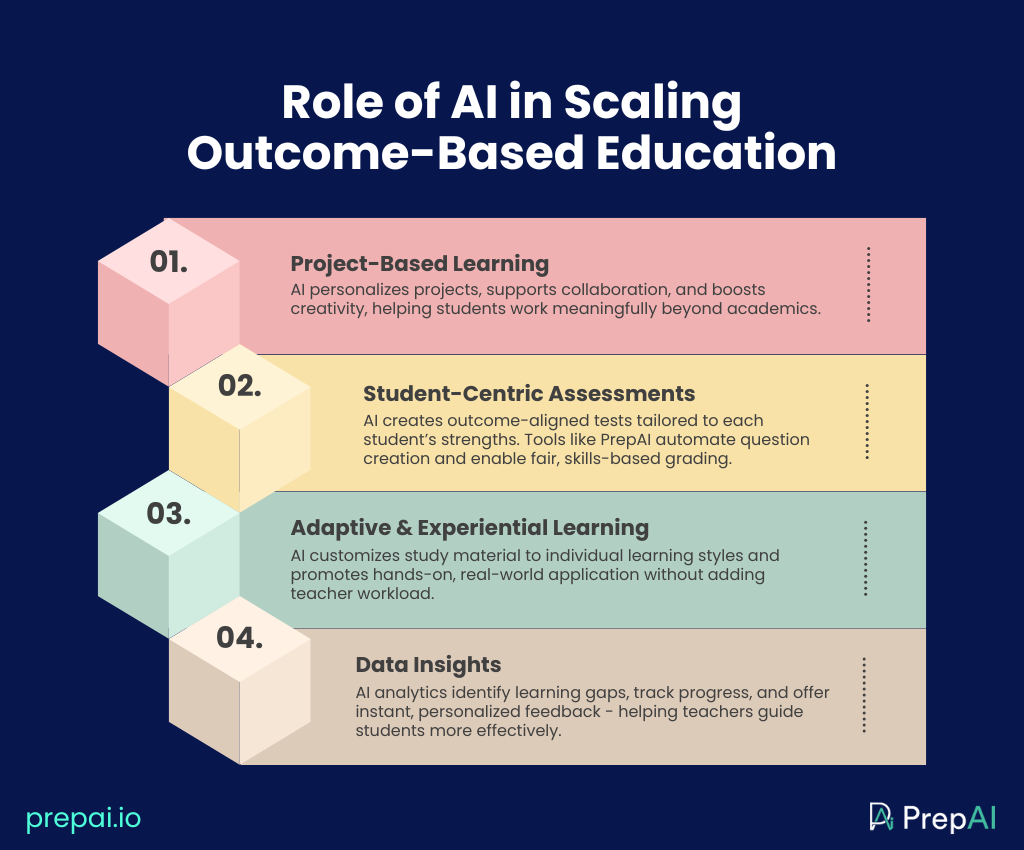
Project-Based Learning
Project-based learning, or PBL, is a student-centric approach that promotes creativity and curiosity in students. Teachers guide students to align the lessons with their interests and preferences so that the projects are more meaningful and useful for them. This is not limited to academic learning but also includes soft skills, personality development, etc. By using AI in outcome-based education for scaling, the projects can be personalized for different student groups, while allowing online and offline collaboration as well as greater engagement. Students can discuss their ideas, share their opinions with peers and teachers, and achieve greater outcomes.
Student-Centric Assessments
An AI-driven learning outcomes assessment model is used to design, implement, and automate student-centric tests. Rather than limit exams to a one-size-fits-all model, the assessments are personalized to evaluate students based on their strengths and how they use their skills and knowledge to achieve the required outcome. PrepAI converts the input content into comprehensive test papers that measure various skills and competencies. Students are not ranked but graded against the set outcomes rather than each other. Still, healthy competition can be created in the classrooms through gamification to encourage students to work harder.
Adaptive and Experiential Learning
AI in classroom teaching allows faculty to adopt different learning/ teaching methodologies. For example, adaptive learning is where the AI algorithms are trained to understand students’ learning preferences and customize the study material accordingly. This turns passive learners into active learners, where they engage with the study material and gain more knowledge. Experiential learning is another methodology that focuses on active student engagement. It encourages students to experiment and be creative, and to apply their knowledge in real-world scenarios. These methodologies help scale outcome-based education without increasing the teachers’ workload.
Data Analytical Insights
Educational analytics and AI go hand in hand. Teachers can derive relevant and meaningful insights by analyzing student data. For example, diagnostic analytics helps in identifying the weak areas students have to work on, while predictive analytics is useful for teachers to prepare students for the future. Their test performance is also analyzed to provide personalized feedback. OBE assessment automation with PrepAI includes instant results and data-driven insights to guide students academically and personally. When faculty combine personal experience with data-based insights, they have the power to transform students’ lives for the better.
Why Choose PrepAI Smart Test Paper Generator
The best way to use AI for continuous assessment is to integrate the powerful PrepAI assessment solution with your educational tools. Built on NLP (natural language processing) algorithms and supported by Bloom’s Taxonomy framework, the platform can be customized and scaled to conduct automated assessments for diverse requirements and outcomes.
PrepAI is a faculty-readiness solution that saves around 10 hours per week per faculty and improves learning outcomes by 20%. Additionally, it comes with accreditation compliance that allows educational institutions to set higher standards, become more consistent, and increase the transparency of their processes. The Lifetime Plan allows the creation of unlimited assessments and enhances students’ learning experience by refining and redefining the assessment process.
To Sum Up
AI in outcome-based education is critical to implement the necessary changes to transform conventional teacher-centric and syllabus-centric learning to a student-centric model. Artificial intelligence assessment solutions like PrepAI facilitate modern evaluation methods while reducing the workload on teachers.
Accurately measure what students can do and how they can improve by integrating PrepAI into your educational processes. Talk to our team to sign up for workshops and learn more about how AI-powered learning-based assessments are the need of the day in the current educational scenario.
FAQs
1. What are the features of outcome-based education, and how does AI help implement these features?
OBE has the following features:
- Flexible curriculum
- Student-centric learning
- Accountability
- Assessment-driven
- Focus on real-world skills
- Continuous improvement
AI in outcome-based education helps in creating curricula, automating assessments with PrepAI, sharing personalized feedback regularly, and helping students implement their knowledge in real-life scenarios.
2. How do AI assessments help in classroom management?
AI assessment solutions like PrepAI are faculty-readiness and outcome facilitators. They help in better classroom management by streamlining the evaluation process and providing analytical insights about each student’s progress. This empowers teachers to guide and support students in achieving the required outcomes by the end of the course.
3. Can AI question generators measure real-world skills?
Yes, the PrepAI question generator can measure real-world skills by creating test papers catering to diverse scenarios and contexts. Additionally, the platform is supported by Bloom’s Taxonomy framework to evaluate the higher-order thinking skills (HOTS) in students. AI in outcome-based education can be seamlessly scaled using PrepAI assessment solution to implement the model throughout the educational institution.
