


Assessment design is a process of creating tests, papers, or exams that helps in measuring student learning. With the right assessment, professors can promote deep learning and improve students' outcomes. Thus, this blog will help you understand why assessment making can become better with AI assessment platforms.
For a long time, assessment design has been treated as an individual responsibility rather than an academic practice that benefits from shared thinking. The basic pattern to prepare an assessment is where one professor drafts the paper, another prepares an answer key, and somewhere between those two points, an entire learning journey is evaluated. The system moves, but not always with confidence. Most of the time, the professor designing the assessment is working alone, making choices in isolation, hoping those choices land in the way they were intended to.
This manual creation of assessment not only takes a huge amount of time but also demands considerable efforts from the professors. The use of AI-based assessments is revolutionary because when teachers, faculty members, or professors across different institutions are asked, a recurring sentiment comes up: designing assessments alone always feels heavy.
This assessment design in education shouldn’t be a solo activity because the professors already have a lot of work to do, and making assessments is actually burdensome for them. To ease this process, it is better to make assessment a collaborative task and use AI-based assessment tools to create an assessment that reduces biases, increases clarity, and enhances student consciousness rather than teacher dependence.
Understand the Hidden Cost of Designing Assessments Alone
If different perspectives are not available when preparing assessments, it is possible that the assessment appears to be lacking something important. Without collaboration between professors, assessment may lack balance. This does not mean that the professors creating the assessment did not have the expertise to create a balanced assessment. However, it does mean that the assessment may not reflect the collective insight of different professors and was not subject to the same level of review and refinement as assessments prepared with collaboration. As a result, students lose clarity, especially when their learning is being measured against a design that has never been questioned or reviewed before reaching them.
The lack of AI in classroom teaching creates barriers like inconsistent difficulty levels, limited question diversity, repetitive patterns across exams, and uneven interpretation of learning outcomes. However, the lack of collaborative effort creates an even bigger issue that leads to no shared mirror to reflect on these challenges before they reach students. When one professor has to be the creator, reviewer, editor, evaluator, and quality checker, errors don’t appear because of negligence; they appear because of isolation.
Most educators don’t talk about these moments. They simply navigate them. With the help of collaboration, both AI and the academic community work together on a common goal to alleviate some of the pressure from professors who have traditionally managed assessment design independently. The academic community provides context; AI provides the framework. Professors need a space where they can discuss and start conversations that begin to matter. With PrepAI Community, a professor can ask how to frame a rubric, a lecturer can request feedback on question sequencing, someone new to teaching can learn how to maintain difficulty gradients, and an experienced academic can contribute insights that others may not have considered.
This is the space where the PrepAI Community begins to matter. It isn’t just a forum or a group; it is an environment where assessment conversations can finally open up. A professor can ask how to frame a rubric, a lecturer can request feedback on question sequencing, someone new to teaching can learn how to maintain difficulty gradients, and an experienced academic can contribute insights that others may not have considered. The work that once happened in isolation becomes visible, discussable, and improvable.
How Does Collaboration Change Assessment Quality?
When assessments are reviewed, co-created, or even lightly discussed, something important happens: the design becomes more representative of learning, not just teaching. The educator does not lose control; they gain clarity. Instead of being responsible for all the answers, they gain the space to ask better questions. AI-assessment platforms showed higher post-test outcomes (85.6% vs 76.4%) and significantly more engagement.
Assessments become more representative when minds and AI contribute. The AI tools like PrepAI help professors to collaborate using their new feature, which is PrepAI Community, where they can discuss, share, and contribute in unique ways that result in:
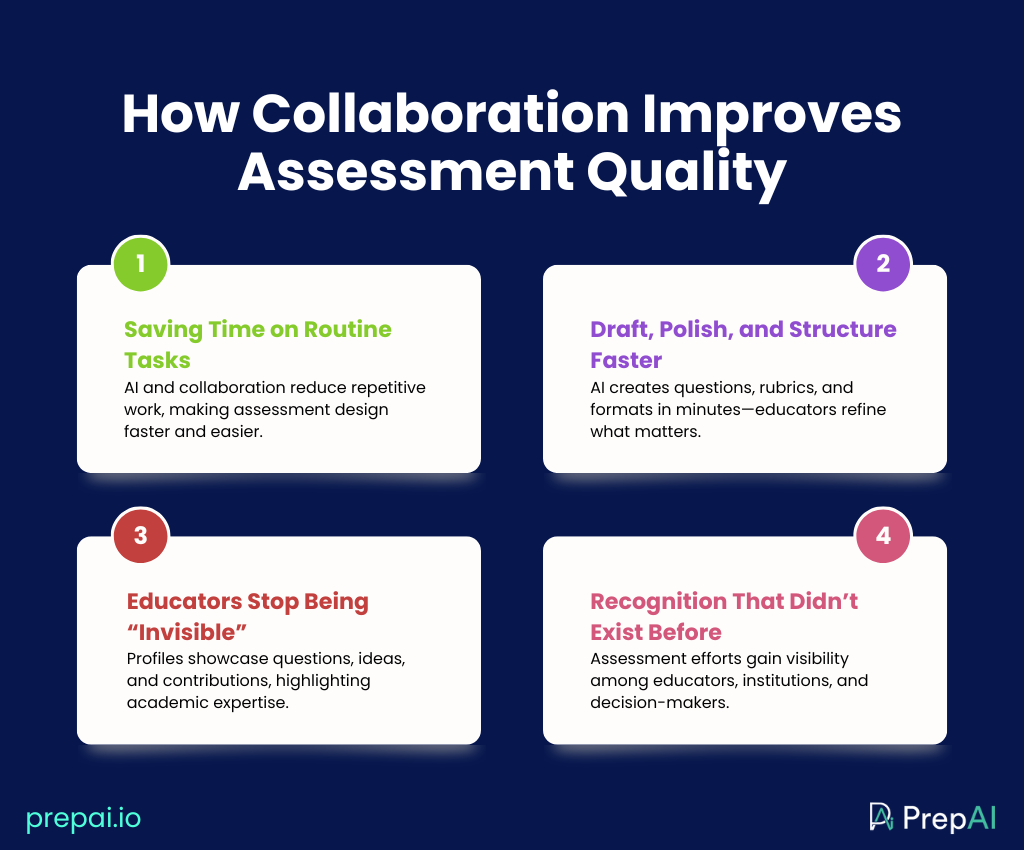
Saving Time on Routine Tasks
AI is expected to grow across all sectors, including education. It is projected to reach USD 70 billion by 2030, highlighting the growing importance of AI. Educators can learn, participate, and co-design together, which leads to:
- Ask doubts about assessment structure, rubrics, or difficulty levels
- Share drafts and get peer feedback before finalizing papers
- Learn how other institutions are designing assessments to improve assessment quality.
- Build assessments with conversations, not isolation
Outcome: Assessment design becomes a shared academic practice, not a silent burden.
AI Can Be Used to Draft, Polish, and Structure Work Faster
PrepAI Community is a part of PrepAI. If you are already using this platform, you must be aware of how this tool works as a solution in assessment design in education. However, if you are new to this platform, professors and teachers can draft questions for students of different types of learners within just minutes using our AI-based assessment platform. The impact of this is far-reaching, due to which professors can:
- Generate first drafts of questions and variations
- Create sample rubrics and marking patterns
- Adjust difficulty levels using Bloom’s Taxonomy
- Save time on formatting, editing, and repetitive tasks
Outcome: AI gives structure, and professors give judgment. When both work together, it can help in reducing assessment bias, and because it speeds up the repetitive parts, judgment can be applied where nuance matters.
Profile Building: Educators Stop Being “Invisible”
In most institutions, professors build their careers quietly. They solve classroom problems on their own, design assessments without support, and handle doubts in private. Their experience grows, but their identity often doesn’t. Inside the PrepAI Community, professors can build their profile that reflects what they teach and how they design assessments. Professors can effectively ask questions and clear doubts without feeling judged for not knowing something. They can even share insights, templates, and methods that have worked for them and help other professors as well. It leads to:
- Every question asked shows initiative.
- Every answer shared reflects expertise.
- Every suggestion builds credibility and gets visibility among departments you’ve never interacted with.
- Every discussion becomes proof of knowledge.
Outcome: Educators start becoming known, not just present.
Recognition That Hasn’t Existed Before
Assessment design is crucial work, but professors rarely get recognition for this and for their other work as well. As PrepAI is already being used by global universities, colleges, and academic decision-makers, the community naturally becomes a discovery space. When professors share insights, ask questions, or help others solve assessment and other related challenges, their profile reflects it, and the right people see it. In the PrepAI Community
- Educators gain visibility for their expertise.
- They can showcase skills beyond the classroom.
- They get noticed by other faculty, institutions, and decision-makers.
Outcome: Recognition without needing a title, award, or certificate.
Conclusion
AI can help in creating assessments of best practices because it reduces assessment bias and improves the quality of the education. Designing assessment was never the responsibility of a single professor, as they will never get any real space to question, compare, rethink, or co-create. The truth is, teaching has always been a collective effort, while assessment has been treated like a private task. And that gap has shaped stress, uncertainty, and invisible work for far too long.
The use of AI-based assessment can ease this stress, as it can help professors and teachers make assessments in one go. These assessments are according to the skills of the learners and help professors analyze where students stand, what concepts they are struggling with, and which areas need reinforcement. Along with it, PrepAI Community is positioned to make professors’ lives easy. By becoming a part of this community, professors can turn experiences into exchange, which quietly becomes clarity.
FAQs
1. What can I actually do inside the community?
Inside the community, educators and professors can:
- Post questions or doubts about assessments
- Share drafts or ideas to get input from peers
- Get clarity on rubrics, difficulty levels, or question patterns
- Discuss best practices from other universities
- Build a profile that reflects academic involvement
2. Do I need to be a tech-savvy teacher to join?
No. The community is designed for everyday educators and professors, not just tech users. If you know how to teach, ask questions, and share your experience, you already have what you need. Everything else can be learned, shared, and discussed inside the community.
3. Is the community free to join?
Yes, joining the community and creating your profile is free. You can participate in discussions, ask doubts, explore insights, and learn from peers without any cost.
4. How does this help in my professional growth?
Every contribution you make: a question, answer, or shared insight becomes part of your public profile. Over time, this builds a visible academic identity that:
- Shows what you know and how you think
- Demonstrates your involvement beyond the classroom
- Helps other educators recognize your strengths
This isn’t just participation; it’s presence.
